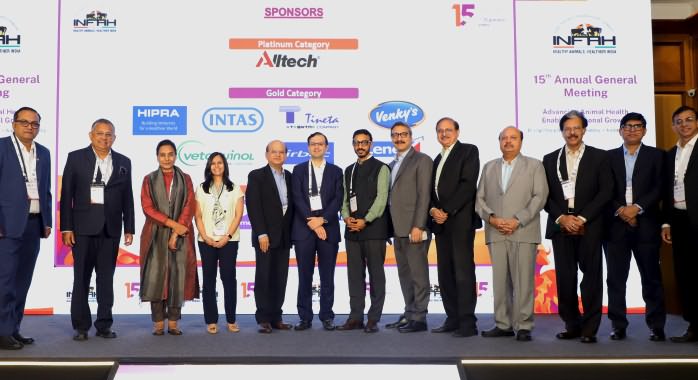
Industry leaders call for a prevention-first, AI-enabled and innovation-led animal health strategy to boost productivity, farmer incomes and nutritional security.
India's next leap in livestock productivity may depend as much on healthier animals as on larger herds, industry leaders and experts said at the 15th Annual General Meeting (AGM) of the Indian Federation of Animal Health Companies (INFAH) in Mumbai, calling for a decisive shift towards prevention-led healthcare, early disease detection and technology-driven animal management.
With animal health increasingly linked to farmer incomes, food security, rural livelihoods and national nutritional security, the AGM brought together industry leaders, regulators, scientists and policymakers to chart a more ambitious roadmap for the sector in the context of Viksit Bharat. Representing more than 85% of India's veterinary biologics, pharmaceuticals, feed supplements and animal nutrition sector, INFAH provided a broad industry platform for discussions on the future of animal health in India.
The message from the meeting was clear: India needs to move from a reactive animal healthcare model to one that predicts, prevents and manages disease before it impacts productivity. Smarter regulation, stronger biosecurity, wider adoption of AI and digital technologies, and deeper collaboration between government, industry and academia were identified as critical to building a resilient and globally competitive animal health ecosystem.
Healthier Animals, Higher Productivity
Delivering the keynote address, Mr. Burjis Godrej, Chairman, Godrej Agrovet, emphasised that the future of Indian animal agriculture lies not merely in increasing livestock numbers, but in improving animal health, nutrition, welfare and productivity.
He called for greater investment in vaccination, diagnostics and preventive healthcare, supported by closer collaboration among industry, academia and government to build a more resilient and globally competitive animal health ecosystem.
Smarter Regulation, Stronger Disease Preparedness
Dr. Rubina Bose, Deputy Drugs Controller (India), CDSCO, highlighted the need for robust yet enabling regulatory systems that support innovation while maintaining high standards of quality, safety and efficacy.
Dr. Naveen Kumar, Director, National Institute of Virology (NIV), Pune, stressed the importance of biosecurity, disease surveillance, biotechnology and vaccine development in preparing for emerging and re-emerging animal diseases.
The discussions reinforced the need to make animal healthcare more preventive, predictive and science-led, with stronger preparedness for disease threats affecting both animal and public health.
AI Takes Animal Healthcare from Reaction to Prediction
Artificial intelligence and digitalisation emerged as powerful tools for transforming animal healthcare and improving farm-level productivity.
Mr. Amit Vyas, Managing Director, Amul Dairy, highlighted the potential of digital advisory systems and technology-enabled veterinary services to improve productivity, decision-making and farmer profitability.
Mr. Hareesh Tibrewala, Founder and CEO, Manabu AI Solutions, showcased applications of AI, computer vision and predictive analytics in disease detection, feed management and livestock traceability across dairy, poultry, aquaculture and companion animal sectors.
The discussions highlighted a fundamental shift underway in animal healthcare—from reaction to prediction, and from the clinic to the farm.
INFAH Marks 15 Years with a Stronger Focus on Member Value and Industry Impact
The 15th AGM also marked 15 years of INFAH's evolution from an industry representative body into a stronger platform for policy advocacy, regulatory engagement and collective industry action.
The President, INFAH, highlighted the Federation's growing role in bringing industry perspectives to the policy and regulatory table and in strengthening collaboration across the animal health ecosystem.
The Secretary, INFAH, placed the focus firmly on member value and measurable outcomes, emphasising that INFAH's next phase must translate collective industry participation into tangible benefits for its members. He highlighted the importance of greater member involvement in shaping policy priorities, regulatory engagement and sectoral initiatives, with INFAH serving as a platform to convert shared concerns into collective action, stronger representation and meaningful outcomes.
The 15th anniversary thus marked not only INFAH's institutional journey, but also a renewed emphasis on voice, value and outcomes for its members as the Federation enters its next phase.
Recognising Those Who Built the Industry
As part of its 15th anniversary celebrations, INFAH recognised the contributions of past presidents, committee chairs, members and industry partners through special ceremonies and the Members' Spotlight programme.
The annual INFAH Awards honoured two distinguished industry veterans for their longstanding contribution and commitment to the animal health sector:
- Dr. Ramesh C. Sikka
- Dr. Raghuvir Krishnarao Trifale
The recognitions celebrated the leadership and contributions that have helped shape India's animal health industry over the past 15 years.
Six Priorities for the Road Ahead
Concluding the 15th AGM, INFAH reaffirmed its focus on six key priorities:
- Strengthening preventive healthcare and biosecurity to address animal disease threats.
- Promoting science-based, predictable and innovation-friendly regulatory frameworks.
- Accelerating the adoption of AI and digital technologies across animal healthcare.
- Improving livestock productivity and farmer incomes through better animal health and nutrition.
- Strengthening the contribution of healthy animals to India's food and nutritional security.
- Deepening government-industry-academia collaboration to address emerging sectoral challenges.
The 15th AGM marked more than a milestone in INFAH's journey. It placed animal health firmly within India's broader growth agenda, while setting out a forward-looking industry agenda centred on prevention, science, technology, collaboration and member value.
Guided by its mission of "Healthy Animals, Healthier India", INFAH reaffirmed its commitment to proactive policy advocacy, innovation and partnerships to build a resilient, sustainable and future-ready animal health ecosystem—contributing to healthier livestock, stronger farmers and a healthier India.